When you configure a proxy server for a Wi-Fi network, your iPhone or iPad will use it when accessing that network. This is sometimes required to access the Internet on a business or school network, for example. Your network traffic will be sent through the proxy you configure. RELATED: Generally, you’ll use a proxy if your school or work provides it to you.
A proxy server is an intermediary between your Windows 10 PC or device and the Internet. This server makes requests to websites, servers, and services on the Internet for you. For example, say that you use a web browser to visit www.wiley.com and your browser is set to use a proxy server.
You could also use a proxy to hide your IP address or that aren’t available in your country, but. If you need to set up a proxy for school or work, get the necessary credentials from them and read on.
Head to Settings Wi-Fi to access proxy settings on an iPhone or iPad. Tap the name of the Wi-Fi network you’re connected to. Scroll down and you’ll see the “HTTP Proxy” option at the bottom of the screen. By default, the HTTP Proxy option is set to “Off”.
This means your iPhone won’t use a proxy at all when connected to the network. To enable automatic proxy detection, select “Auto”. Your iPhone will use the Web Proxy Auto-Discovery Protocol, or WPAD, to see whether a proxy is necessary on the Wi-Fi network and automatically configure your proxy settings if one is required. This feature is often used on business and school networks.
How To Set Proxy On Windows 8
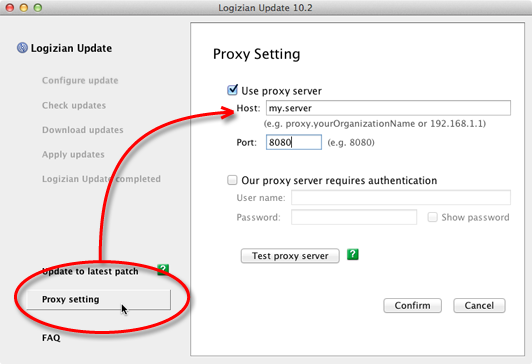
If your current network doesn’t provide proxy details using the WPAD protocol, your iPhone or iPad won’t use a proxy, even if you select “Auto” here. To use an automatic proxy configuration script, sometimes called a.PAC file, select “Auto” and enter the address of the proxy auto-configuration script into the “URL” box. IOS will instead use the proxy auto-configuration script instead of WPAD to enable your proxy. If your network administrator or proxy service provider wants you to use a proxy auto-configuration script, it will provide you with the address of the file. To manually specify a proxy server’s address and port, select “Manual”. Enter the address of the proxy server in the “Server” box and the port it requires in the “Port” box. Your organization or proxy service provider will provide you with these details.
If the proxy server requires a username and password—your proxy provider will let you know if it does—enable the “Authentication” option here. Enter the username and password the proxy server requires in the “Username” and “Password” boxes.
If your iPhone or iPad can’t connect to the proxy server—for example, if the proxy server goes down or if you enter its details incorrectly—you won’t be able to access websites and other network addresses. For example, in Safari you’ll see a “Safari cannot open the page because the server cannot be found” message, and in the App Store you’ll see a “Cannot Connect to App Store” message. Other applications will display their own network error messages. You’ll need to fix your proxy settings before you can continue accessing the Internet on that Wi-Fi network. The proxy settings you configure are unique to each Wi-Fi network. In other words, if you want to use the same proxy on three different Wi-Fi networks, you’ll have to enable it separately for each Wi-Fi network, entering the server details three times. That’s because you may need to use a proxy while connected to the Wi-Fi network at your workplace, but not at home or on other Wi-Fi networks.
If you’d like to set up a global HTTP proxy that’s used when connected to all Wi-Fi networks, you’ll have to and that enables a proxy on all connections. Apple considers this a feature for businesses, schools, and other organizations, so it requires enterprise-grade configuration tools.
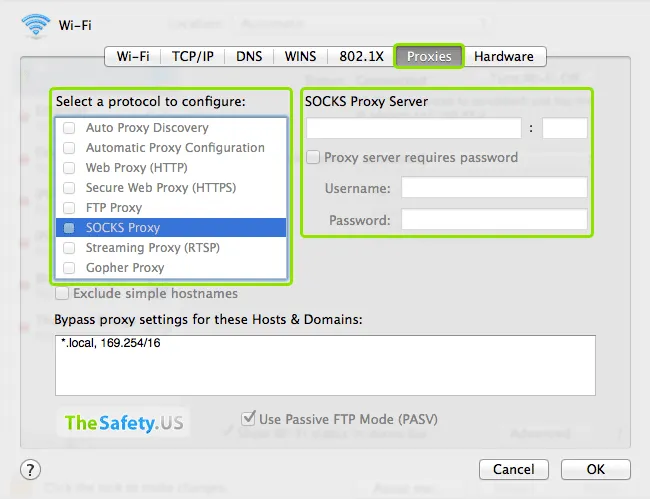
I am using an HTTP proxy on MacOS 10.7 (which works for Safari.app, when set in the system preferences). I'm now trying to set the proxy for command-line applications using the $httpproxy environment variable.
However, I'm seeing the following error (proxy details replaced by uppercase variables $ export httpproxy=PROXY:PORT $ wget -2012-01-31 17:31:31- Resolving PROXY (PROXY). Free visio viewer for mac os x. PROXYIP Connecting to PROXY (PROXY) PROXYIP :PORT. Failed: Connection refused. Any ideas what I might be doing wrong?
Astrofrog I hope this is not a dumb answer but do you have real values for PROXY and PORT. It should normally look something like export httpproxy=or export httpproxy=Also try setting the variable in caps eg. Export HTTPPROXY=Finally there is normally some sort of authentication verification on the proxy for example it might need to be configured to check the source address. Is your address configured on it?
Connection refused indicates that that the given ip address and port are atleast in theory valid but the host is blocking the connection because a) firewall doesnt let your connection to the actual proxy server software or b) there is no proxy server running in that particular host in that particular port. First line of debugging this would be to use telnet in terminal. telnet PROXY PORT. telnet PROXYIP PORT If both cases fail with 'connection refused', problem is in the other (proxy) end or you dont have proper name/ip/port for your proxy. If either one fails and another works, there's definitely some sort of dns error (which again, you might not be able to fix on your own) PS. Atleast on linux, typically http and https proxy variables are exported with full urls including the protocol: export httpproxy=.